
Did you know that German software powers numerous business-critical ordering and banking processes behind the scenes—and yet far too few people are aware of it? Camunda.
On the “Unicorn Bakery” podcast, founder Jakob Freund himself sums it up: If Camunda goes down, you won’t be able to order anything from Zalando. And you won’t be able to make a bank transfer.
And yet it’s a term that hardly anyone outside of IT departments is familiar with. Business-critical, yet invisible. This exact pattern—enormous leverage, yet virtually unknown—applies to the entire discipline behind it: process automation and orchestration.
Why This “Invisibility” Is Coming to an End Right Now
For a long time, automation projects were viewed primarily as individual technical use cases:
- Automate manual data entry,
- connect two applications,
- digitize an approval step,
- automatically classify documents,
- have an AI agent verify information.
Each of these use cases can be useful.
The problem arises when companies implement more and more of these solutions without clarifying who will ultimately manage the overall process.
- Who knows what stage a specific customer request is currently at?
- What happens if a bot has completed its task but the downstream system is unavailable?
- Who takes over if an AI agent cannot reach a definitive conclusion?
And especially when you follow the LinkedIn AI bubble, the question arises:
- How can we prevent different departments from automating the same process in parallel using various AI tools that are currently trending?
Analysts now group these developments under terms such as “Business Orchestration and Automation Technologies,” or BOAT for short. The idea behind this is simple:
“The more automation tools a company uses, the more important it becomes to have a layer that ties the entire process together.”
Gartner therefore predicts that by 2029, about 80% of all companies with mature automation practices will transition from isolated siloed solutions to consolidated platforms. Simply to be able to bring the resulting process chaos under control. Gartner has positioned Camunda als a “Visionary” in this new segment, Forrester rates the platform highly in terms of Orchestration performance received the heighest rating af 5 out of 5.
„Scaling is harder than starting“
At this year’s CamundaCon, I was able to see many concrete examples of how Camunda customers (Hapag-Lloyd, HDI, Barclays, Audi, Commerzbank, Provinzial, etc.) are using the solution in various presentations. The real insight, however, didn’t come from the stage, but from the open discussions at the event.
“Scaling is harder than starting” was the phrase I heard most often. Today, technical implementation is often no longer the biggest hurdle. Scaling, business unit adoption, governance, and process transparency are becoming more challenging. (Keyword: process documentation).
After all, building an initial automation solution is relatively easy these days. The tools are powerful, cloud services are readily available, and AI now even supports the design and implementation phases. An initial proof of concept can be developed within a few days.
The real challenge begins afterward.
- How does a successful use case become a stable business process?
- How are business units involved?
When Local Automation Successes Become a Problem
And this is exactly where the discrepancy lies. Due to operational overload and a deep fear of the “next, sluggish, massive IT project,” many departments are currently developing decentralized, standalone solutions.
A department has a specific problem and doesn’t want to wait for the next big IT project. So the team builds a workflow with n8n or Make, automates a task with UiPath, or develops its own AI assistant.
This initially resolves a specific pain point and can quickly provide noticeable relief. That’s precisely why this decentralized approach is so appealing. The problem arises when these many local successes fail to coalesce into a unified, overarching process.
Then suddenly there are:
- multiple automated processes for similar tasks,
- inconsistent data states,
- difficult-to-trace dependencies,
- unclear responsibilities,
- manual handoffs between automated segments,
- and a lack of transparency when errors occur.
The result is not an end-to-end process, but a network of individual solutions. Or, to put it another way:
“Process chaos turns into automated process chaos.”

Automation isn’t always the first step
So anyone who accumulates isolated tools without an overarching blueprint will ultimately only accelerate the existing chaos. And in most cases, the actual foundation is missing from the start: processes exist in people’s minds and in Excel spreadsheets, not in systems.
That’s why process transparency is the first step! This can be achieved through workshops, BPMN modeling, task mining, or process mining—for example, using SAP Signavio or Celonis.
If you don’t know where in the process time is actually being wasted, you risk automating the wrong part—and then wonder why you’re not seeing results. The technology itself isn’t the key factor here.
The crucial question is:
“Do we know what problem we want to solve in the overall process?”
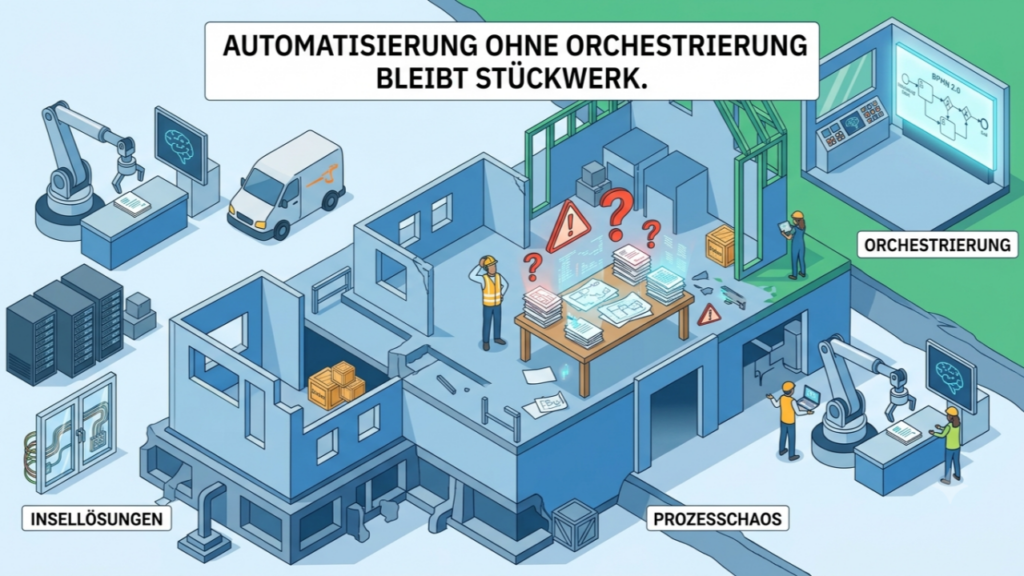
A helpful image: the automation construction site

Camunda serves as the project manager for the automation project. The project manager maintains the digital blueprints (the process models based on BPMN 2.0), which all stakeholders refer to.
One example is the “Onboarding a New Employee” project: IT access, the HR system, facility management, SIM card orders, and management must all be coordinated without anyone being overlooked or the new employee having to wait for her laptop or smartphone.
It is precisely these types of end-to-end processes that are Camunda’s primary focus—rather than the isolated automation of a single click or data transfer. Camunda integrates specialized tools such as UiPath, n8n, or AI agents into a unified end-to-end process.
The process steps can be transparently logged and evaluated, which can be crucial—especially for business-critical, regulated, or audit-relevant processes. All of this is coordinated over the course of weeks, so that the end result is a turnkey house—not just individual finished walls.
UiPath is the construction machine. It is particularly powerful when specific, rule-based tasks in existing applications need to be automated. It handles precise, repetitive tasks in cases where existing applications are difficult to integrate via modern interfaces.
Specifically, this means:
- SAP GUI screens where clerks enter data manually every day.
- Citrix environments that many organizations still use to access their core systems.
- Mainframe terminals with green screens that have been running for decades and that hardly anyone knows how to use anymore.
Especially in situations where no modern interface is available, UiPath robots can operate applications much like a human would, without necessarily requiring technical changes to the underlying system.
n8n and Make handle construction site logistics. They specialize in integration, data, and workflow automation. On the construction site, they ensure that materials and information reach the right station.
Their job: They connect applications, transfer and transform data, and trigger follow-up actions.
For example:
- When an email arrives in Gmail, create a post in Slack—classic point-to-point integration, quick to set up, and immediately useful.
This approach is fast, flexible, and perfectly adequate for many scenarios. That’s why these tools are particularly well-suited for rapid integration and automation scenarios. Their use often begins on a decentralized basis within individual teams or departments.
The boundaries are not absolute
Of course, reality is more nuanced than any metaphor. With Maestro, UiPath now even offers features for orchestrating complete processes. n8n and Make can also map complex workflow chains, wait times, and error paths.
The crucial question, therefore, is not what a tool can or cannot do in principle, but rather what role the tool should play in the overall architecture. A company can attempt to map an entire business process within a single integration tool.
However, it can also choose to separate them deliberately:
- Camunda coordinates the end-to-end process.
- UiPath performs UI-based tasks.
- n8n or Make connect applications.
- AI agents handle knowledge-based tasks.
- Business decisions are made by people or rules.
The advantage of this separation is not in using as many tools as possible. The advantage lies in using the right tool for each task while still maintaining a shared process status.
A key strength of Camunda is BPMN 2.0: an established visual process language that enables business users and IT to describe a shared workflow. Business users define the desired behavior, while IT can technically implement and execute the model. This is the foundation for true adoption.
Automation is not an end in itself
What really motivates me in this field is that it’s not about cutting jobs. According to the McKinsey Global Institute AI and automation could already account for more than 58% of working hours in European companies today.
However, the report emphasizes that this describes technical feasibility—not necessarily actual implementation or job losses. As data processing and mindless, repetitive tasks are taken over by systems, critical thinking, empathy, and leadership are becoming increasingly important.
In many companies, employees currently act as service providers for their own processes rather than as architects of their business. It is precisely this human intelligence that needs to be freed from repetitive routines so that it can once again shine where it truly matters: in complex decisions, human relationships, and genuine value creation. This allows existing capacity to be deployed more effectively for decision-making, customer contact, and process improvement.
The real question
Companies don’t necessarily need fewer automation tools. They need clarity on how these tools work together.
Otherwise, you end up building individual walls that don’t follow a common blueprint. Before you launch your next automation project, you should ask yourself three questions:
1. Which part of the overall process are we actually improving?
2. Who knows the status of the entire process at all times?
3. What happens if a system, bot, workflow, or AI agent fails?
If these questions can only be answered for individual segments, there’s likely a lack of overarching orchestration.
At best-blu, we help companies first map out their processes, select suitable automation tools, and integrate them into a manageable end-to-end process.